Plantain Puff Puff
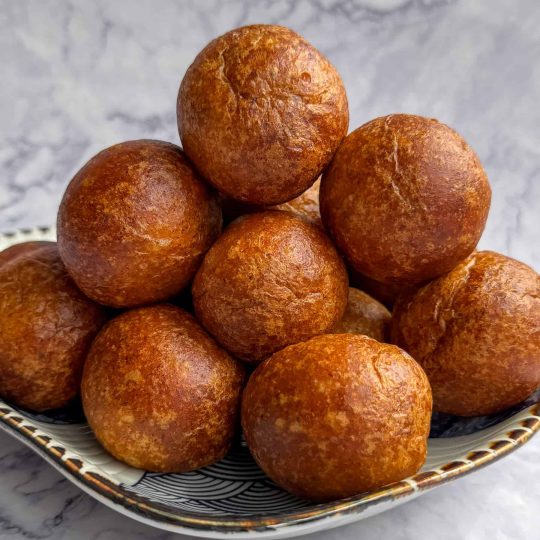
Puff puff holds a very special place in my heart. Being half Nigerian and half Cameroonian, I grew up eating these sweet, golden fried doughnuts, known as puff puff in Nigeria and beignets in Cameroon. Light, airy and gently spiced with nutmeg, they’ve long been one of my favourite treats.
This plantain version came about when I found myself with a couple of very overripe plantains on the kitchen counter. I already prefer a slightly sweeter puff puff, so it felt like a natural way to put them to good use. The plantains add a subtle sweetness and depth of flavour that works beautifully here, making these puff puff even more moreish.
- Prep Time: 20 minutes
- Total Time: 3 hours, including rise time
- Yield: 8 to 10 1x
- Category: Dessert
- Method: Frying
- Cuisine: Nigerian
- Diet: Dairy-Free, Pescatarian, Vegan, Vegetarian
Ingredients
Scale
- 7g active dried yeast
- 250ml warm water (around 43°C)
- 2 tbsp white granulated or caster sugar
- 400g plain flour
- ¾ tsp fine sea salt
- ½ tsp ground nutmeg
- vegetable oil, for deep-frying
For the blended plantain:
- 2 very, very ripe medium plantains
- 50ml water
Instructions
- In a large mixing bowl, whisk together the active dried yeast, warm water and sugar. Leave the mixture to sit for 5 to 10 minutes. It should become foamy, or at the very least frothy, which is how you’ll know the yeast is alive and well. If nothing happens, you’ll need to start again with fresh yeast.
- Meanwhile, place the plantains and water in a blender and blitz until completely smooth. Add the blended plantain to the yeast mixture and whisk until fully combined.
- Add the plain flour, salt and ground nutmeg and mix with a wooden spoon, rubber spatula or your hand (if you’d like to do it the traditional way) until a thick batter forms. The batter should be soft, sticky and stretchy.
- Cover the bowl with cling film and leave somewhere warm until the batter doubles in size. This can take as little as 45 minutes on a very hot day or up to 2½ hours on a very cold one.
- Fill a large, deep Dutch oven or saucepan halfway with vegetable oil and place over a medium-high heat. Heat the oil to 170°C. If you don’t have a thermometer, drop a small amount of batter into the oil. It should sizzle immediately and float to the surface within a few seconds.
- Give the batter a couple of stirs to knock out some of the air.
- The trickiest part of this recipe is frying the puff puff. Not so much the frying itself, but shaping the very wet batter into balls. The traditional method is to wet your hand, scoop up some batter and squeeze it between your thumb and forefinger, allowing a small, ping-pong-sized ball of batter to drop directly into the oil. Continue until the pot is comfortably full but not overcrowded. Depending on the size of your Dutch oven, you may need to fry in batches.
- If that feels a little daunting, use a small cookie scoop or tablespoon instead. Dip it briefly into the hot oil, scoop up some batter and carefully drop it into the oil, keeping it as close to the surface as possible to minimise splashing. Repeat until the pot is full but not overcrowded. Whichever method you choose, don’t worry too much about achieving perfect spheres; whether they’re beautifully round or a little misshapen, they’ll still taste fantastic.
- Fry the puff puff for 5 to 7 minutes, turning regularly, until golden brown all over. If the batter has risen well, some of them may even flip themselves over as they cook, but don’t worry if they don’t. Keep an eye on the oil temperature throughout. If it gets too hot, the outsides will brown too quickly, leaving the centres undercooked.
- Using a slotted spoon, transfer the puff puff to a paper towel-lined plate and leave to drain.
- Repeat with the remaining batter. Plantain puff puff is best enjoyed warm, so try not to leave them waiting too long before diving in.
Find it online: https://zenaskitchen.com/plantain-puff-puff/