Homemade New York Bagels
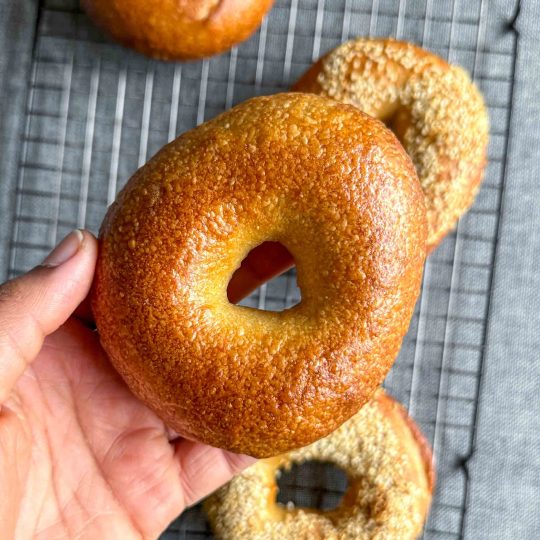
Homemade bagels are infinitely better than the shop-bought kind and they’re easier to make than you might think. They just take a little bit of time, which makes them perfect for a weekend baking project.
- Prep Time: 35 minutes
- Total Time: 14 hours
- Yield: 6 bagels 1x
Ingredients
Scale
For the bagel dough:
- 265g lukewarm water (it’s the same value in ml; I just find weighing more precise for an amount like this)
- 25g barley malt syrup or extract (see Notes for substitutes)
- 4g active dried yeast
- 450g strong white bread flour, plus more for dusting
- 10g fine sea salt
- neutral oil, for brushing
For assembly:
- 3 litres water
- 100g barley malt syrup or extract
- 15g bicarbonate of soda (aka baking soda)
- 10g fine sea salt
- toppings of choice: sesame seeds, poppy seeds, everything seasoning, etc. (optional)
Instructions
- In a small bowl, whisk the lukewarm water, barley malt syrup and active dried yeast until the latter two dissolve, then let sit for 5 minutes. The mixture should get foamy, or at the very least, creamy. If it doesn’t, your yeast is dead and you’ll need to start again with fresher yeast.
- In a large bowl, whisk the strong white bread flour and fine sea salt, then make a well in the middle. Add the yeast mixture and mix with a rubber spatula or wooden spoon until the dough comes together in a shaggy mass.
- Knead the dough in the bowl until it comes together in a solid mass, then turn it out onto a clean surface and knead until you have a stiff but supple and smooth dough with a barely tacky feel, 15 to 20 minutes. It’s a long time, yes, but that’s what will help develop the gluten, which in turn will yield a deliciously chewy bagel.
- Roll the dough into a ball, dust it lightly with flour and transfer to a clean large mixing bowl. Cover tightly with cling film then leave to rise at room temperature for 1 to 1 ½ hours, or until doubled in size.
- Punch down the dough to expel the air, then turn the dough out onto a clean, un-floured work surface. Divide the dough into 6 equal pieces.
- Working one at a time, and keeping the other pieces covered in cling film, form each piece into a ball by rolling it with a cupped hand. Cover the balls with a damp cloth and leave to rest for 5 minutes.
- Meanwhile, line one extra-large (45 cm x 33 cm) baking sheet, or 2 medium baking sheets, with greaseproof paper and brush very lightly with oil.
- Now it’s time to roll the bagels. There are two methods for this. The first is to poke a hole through the centre of the ball to create a doughnut shape. Gently pick the doughnut up, place both index fingers through the hole and rotate your fingers around each other, gradually stretching the hole until it’s about 5 cm in diameter.
- The second method, preferred by proper bagel makers, requires rolling the ball into a 20 cm-long rope. Apply extra pressure to both ends of the rope to thin them out slightly. Place one end of the rope in the palm of your hand and wrap the rope around the back of your hand to complete the circle, overlapping the ends by 4-5 cm. Squeeze the overlapping ends, then press the seam into the work surface and roll your hand back and forth to seal. Slip the dough ring off your hand and gently stretch it to create a hole that’s about 5 cm in diameter, evening out the thickness of the ring as you go.
- Place the formed bagels on the greaseproof-lined baking sheet(s), spacing them evenly (if you’re doubling the recipe, you’ll need double baking sheets).
- Lightly brush each bagel with oil (alternatively, you can use oil spray) and cover loosely with cling film, followed by a damp tea towel. Refrigerate overnight, or for up to 2 days.
- Place an oven rack in the centre position and heat your oven to 230℃ / fan 210℃. Preheat it for a full hour before baking the bagels – this will ensure your oven is hot enough to properly seal, set and bake the bagels.
- Fill a large Dutch oven with water and place on the stove (don’t turn it on yet). If using toppings, place your toppings on small plates ready for later.
- Take the bagels out of the fridge and check if they’re ready to boil and bake with what’s known as the “float test”. Fill a small mixing bowl with cold water. Lightly oil your hands then gently peel one of the bagels off the greaseproof-paper and transfer to the cold water. If it floats, your bagels are ready to boil and bake. Remove the bagel from the water, gently pat it dry and place back onto the greaseproof-lined tray. Note: if one bagel’s ready, they’re all ready. If it fails the float test, don’t worry. Let the bagels sit at room temperature for 20 minutes, then retest every 10 minutes until it floats.
- Cover the Dutch oven and bring the water to a boil over high heat, then lower the heat to maintain a gentle boil. Whisk in the barley malt syrup, baking soda and salt, then skim the scum that rises to the surface.
- With oiled hands, carefully transfer as many bagels as will comfortably fit in one layer to the Dutch oven, leaving enough for them to bob around. Boil for 1 minute, flipping halfway through with a slotted spoon, then transfer back to the greaseproof-lined pan, domed-side. Note: the bagels will puff up in the water then deflate once back on the tray. This is normal, don’t worry – they’ll puff back up as they bake. Repeat with the remaining bagels.
- If using toppings, gently dunk the bagels into the toppings domed-side-down and swirl to cover, then flip and place back on the greaseproof-lined baking sheet.
- Bake for 8 minutes, then rotate the baking sheet 180 degrees and bake for a further 8 minutes, or until brown. Transfer to a wire rack and cool for at least 30 minutes before slicing.
- Bagels are best the day they’re baked (no need for toasting!), but they also freeze really well. Stored in a resealable freezer bag, they’ll keep for up to a month.
Notes
An equal amount of molasses or honey is a passable substitute for barley malt syrup. Neither will impart the traditional malty flavour but your bagels will still be miles better than shop-bought ones!
Find it online: https://zenaskitchen.com/homemade-new-york-bagels/